
“Best Salesforce consulting for small business” usually means one thing: you want Salesforce set up correctly—fast, within budget, and in a way your team will actually use.
Because for small businesses, Salesforce success isn’t about “maximum customization.”
It’s about:
A clean pipeline that matches how you sell.
Simple automation that saves time every day.
Reporting that answers real questions in 30 seconds.
A system that doesn’t collapse the moment someone leaves the company.
This guide shows you how to choose the best Salesforce consulting for a small business—without getting trapped in enterprise bloat, vague proposals, or endless add-ons. (And yes: it’s written for real-world SMB constraints.)

Salesforce consulting can include:
Implementation: configuring Sales Cloud/Service Cloud, security, objects, fields, and automation.
Data migration: importing contacts, accounts, deals, activities, and historical data.
Integrations: connecting Gmail/Outlook, marketing tools, accounting (QuickBooks/Xero), telephony, e-signature, etc.
Training + adoption: role-based training so your team actually logs activity and updates stages.
Ongoing admin/support: small monthly retainers to keep everything healthy.
What it shouldn’t mean for SMBs:
A six-month “discovery phase.”
Custom code for problems that standard features solve.
A CRM that only one internal power user understands.
If someone searches best Salesforce consulting for small business, they’re typically trying to solve one (or more) of these pains:
“We bought Salesforce and nobody uses it.”
“Our pipeline is a mess and leadership doesn’t trust reports.”
“We’re stuck in spreadsheets and need one source of truth.”
“We need to automate follow-ups and stop missing leads.”
“Our support inbox is chaos.”
So the “best” consultant isn’t the biggest. It’s the one who can deliver small-business outcomes quickly.
Great consultants start with a minimum viable CRM:
Core pipeline
5–15 essential fields
Simple reports
One or two automations
Then they expand only after your team is using the system daily.
Small businesses don’t fail because Salesforce can’t do something.
They fail because:
Sales reps don’t update records.
Managers don’t coach in the CRM.
No one trusts the data.
The best consultants design processes your team will follow even on busy days.
Expect a strong consultant to ask:
“What’s your one KPI for this project?”
“What do we stop doing once Salesforce goes live?”
“Which steps in your process create the most bottlenecks?”
Small business consulting is decision-making support as much as it is configuration.
Prices vary by region, complexity, and integrations, but here are practical SMB ranges:
Starter setup (basic Sales Cloud): $5k–$20k
Standard SMB implementation (Sales Cloud + migration + training): $20k–$60k
Sales + Service + integrations (multi-team): $60k–$120k+
Ongoing support/managed admin: $500–$3,000/month (typical for SMB)
If a consultant refuses to give even a rough range, that’s usually where scope creep begins.
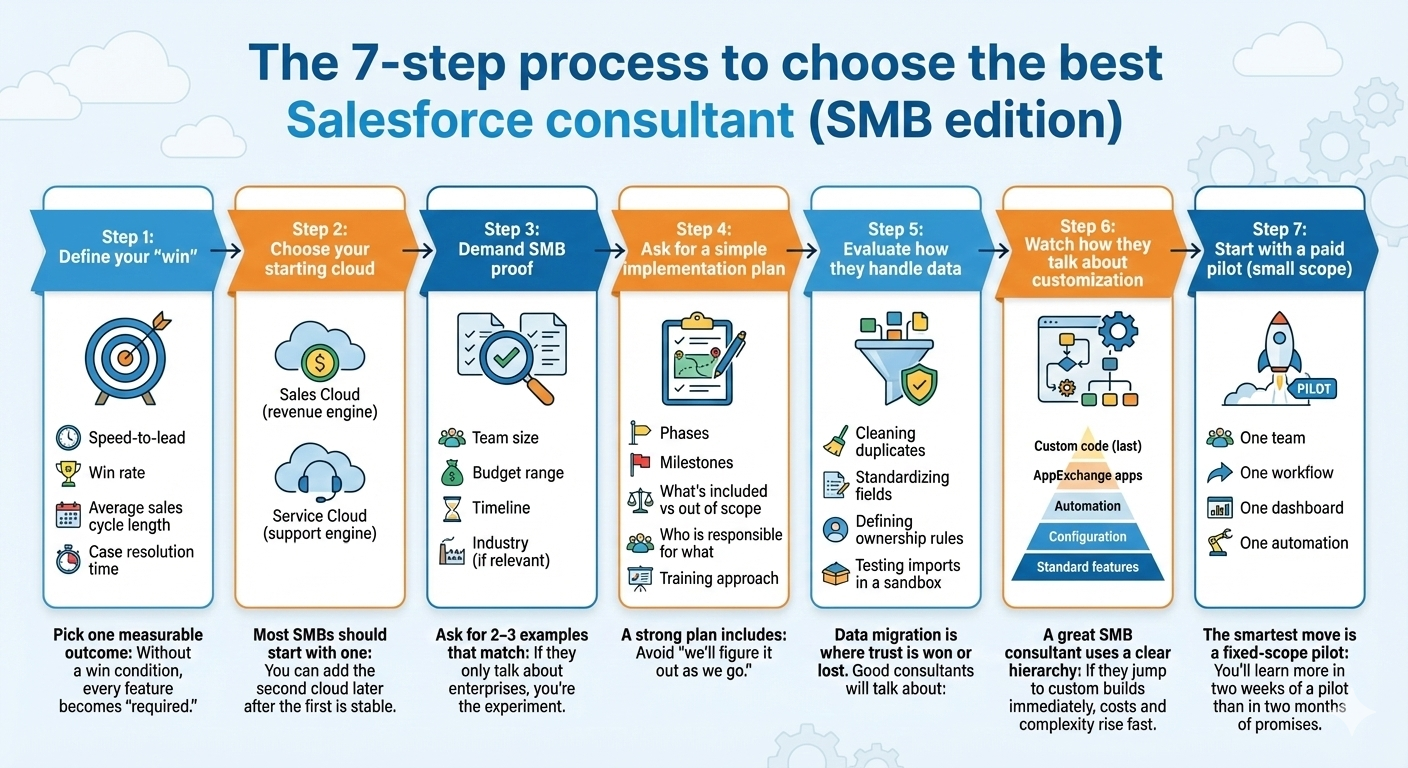
Pick one measurable outcome:
speed-to-lead
win rate
average sales cycle length
case resolution time
Without a win condition, every feature becomes “required.”
Most SMBs should start with one:
Sales Cloud (revenue engine)
Service Cloud (support engine)
You can add the second cloud later after the first is stable.
Ask for 2–3 examples that match:
team size
budget range
timeline
industry (if relevant)
If they only talk about enterprises, you’re the experiment.
A strong plan includes:
phases
milestones
what’s included vs out of scope
who is responsible for what
training approach
Avoid “we’ll figure it out as we go.”
Data migration is where trust is won or lost.
Good consultants will talk about:
cleaning duplicates
standardizing fields
defining ownership rules
testing imports in a sandbox
A great SMB consultant uses a clear hierarchy:
standard features
configuration
automation
AppExchange apps
custom code (last)
If they jump to custom builds immediately, costs and complexity rise fast.
The smartest move is a fixed-scope pilot:
one team
one workflow
one dashboard
one automation
You’ll learn more in two weeks of a pilot than in two months of promises.
Vague pricing (“Contact us” only)
Overpromised timelines (“Full CRM in under 6 weeks” without details)
No adoption plan (training is an afterthought)
Tool obsession (lots of apps, little clarity)
Poor responsiveness during sales conversations
One-person dependency (everything relies on one “guru”)
Small businesses need reliability, not heroics.
“What does a typical small-business implementation cost and why?”
“What would you recommend we not build in phase one?”
“How do you prevent scope creep?”
“How do you handle duplicates and bad data?”
“What does training look like for sales reps vs managers?”
“What happens after go-live—what support is included?”
“What are the top 3 mistakes you see small businesses make with Salesforce?”
The best consultants will answer clearly and push back when needed.
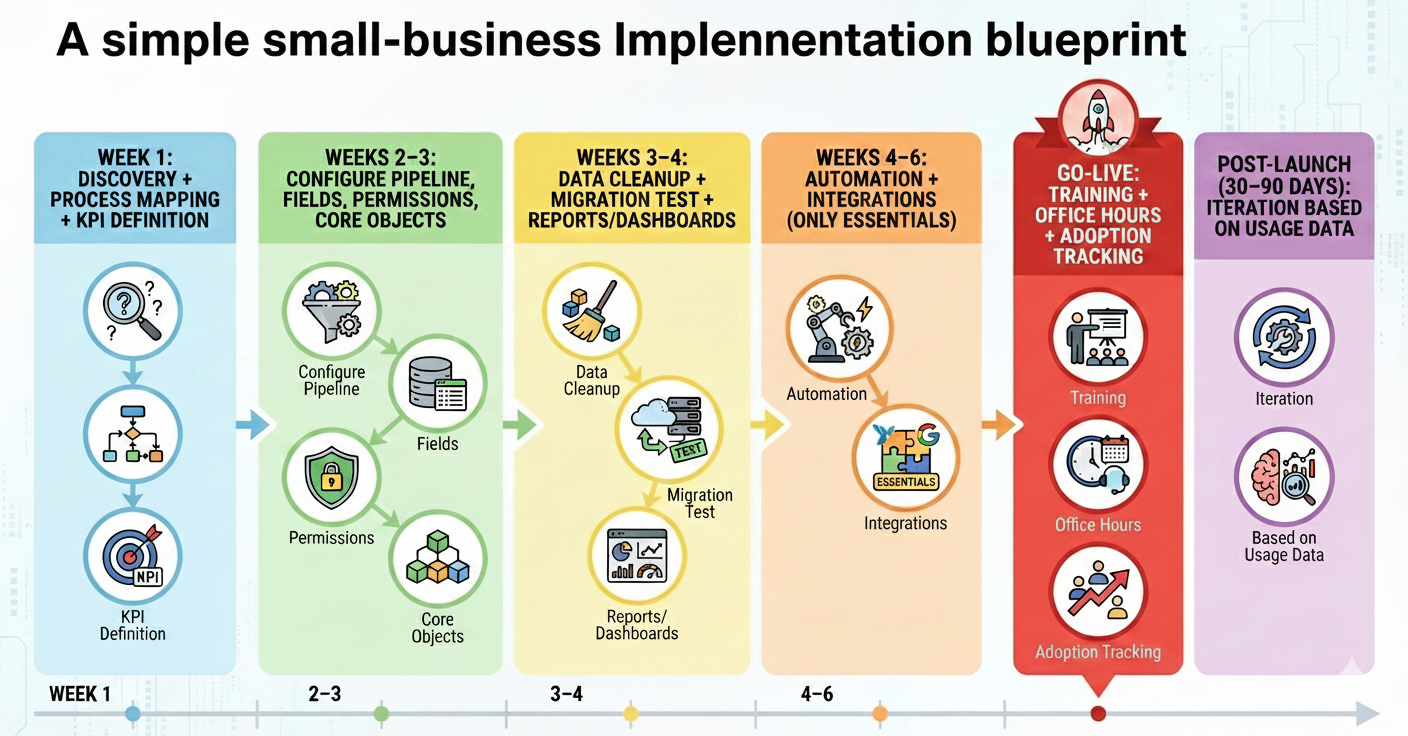
If you want a clean, practical rollout, aim for:
Week 1: discovery + process mapping + KPI definition
Weeks 2–3: configure pipeline, fields, permissions, core objects
Weeks 3–4: data cleanup + migration test + reports/dashboards
Weeks 4–6: automation + integrations (only essentials)
Go-live: training + office hours + adoption tracking
Post-launch (30–90 days): iteration based on usage data
Not every project fits this perfectly, but if there’s no structure at all, outcomes suffer.
The best Salesforce consulting for small business isn’t about doing more. It’s about doing the right things in the right order: define one measurable win, build a simple MVP, migrate clean data, automate only what matters, and train each role to succeed.
Choose a consultant who communicates clearly, prices transparently, and cares about adoption as much as configuration—and Salesforce will become a growth system instead of a costly software subscription.
If you share your business type (SaaS, agency, services, manufacturing, ecommerce), team size, and whether you need Sales Cloud or Service Cloud first, the outline can be tailored to your exact use case.
Read more : Salesforce Pricing for Small Business India (2025)

 Chatbot