
Startup founders don’t buy Salesforce for “features.”
They buy it because they need a repeatable revenue engine: clean pipeline, predictable forecasts, and one place where marketing, sales, and success see the same customer story.
The problem? Most teams are already maxed out. No one has time to learn every nuance of Sales Cloud, design a data model, plan migration, build automations, and train reps—while also shipping product and fundraising.
That’s where Salesforce CRM consulting for startups comes in.
Not as a bloated enterprise project.
As a focused partner that helps you:
Ship a usable CRM in weeks, not months
Align Salesforce with your real sales motion
Automate the boring 60% of work
Set up a foundation that actually scales
This guide breaks down exactly what to expect from startup‑focused Salesforce consulting: what they do, what it costs, where the ROI comes from, and how to avoid enterprise-style overkill.
Could you technically set up Salesforce yourself? Sure.
Should you, while juggling product, hiring, and runway? Probably not.
Startups have three constraints:
Time: You can’t spend 3 months “learning Salesforce”
Headcount: No spare full-time admin at Seed/Series A
Risk: A bad implementation kills adoption and trust
Consultants with startup experience understand that your CRM must:
Map to your current go‑to‑market (PLG, outbound, partner, hybrid)
Support multiple tools (HubSpot, Stripe, Intercom, Slack)
Start lean, then expand as you grow
They’re not just “Salesforce experts.” They’re how you buy back time and de‑risk a system that touches every deal.
A good startup-focused consultant acts like a fractional RevOps + admin + architect. They help you:
They’ll start with questions like:
What’s your primary motion? Inbound, outbound, PLG, channel?
Who owns the customer at each stage?
What metrics matter this quarter?
Then they design a lean data model and process that matches reality—not a textbook sales cycle.
For most early-stage startups choose the right edition:
Starter Suite: cheapest way to get CRM + basic automation
Pro Suite: unlocks deeper customization and workflows as volume grows
Your consultant will recommend where to start and when to upgrade to avoid rework.
Following modern best practices, a solid implementation plan follows a clear roadmap: discovery → design → planning → customization → testing → training → deployment → optimization.
You should see:
Documented requirements
Configuration over code
Clear testing and launch plan
Post‑go‑live improvement loop
They’ll:
Audit your current tools (HubSpot, Pipedrive, spreadsheets, product DB)
Map what to bring into Salesforce—and what to leave behind
Clean and dedupe data before import
Run test migrations in a sandbox
Result: reps log in Day 1 and see usable, trustworthy records, not garbage.
For example:
Lead routing and SLAs
Qualification task sequences
Trial → sales handoff workflows
Renewal and expansion reminders
The best consultants use config + Flow first, code last, so you’re not locked into expensive dev work.
They don’t just “hand over” an org. They:
Run role-based training (SDR, AE, CSM, leadership)
Provide quick‑hit SOPs and Loom videos
Help define “this is how we sell” inside Salesforce
Because a perfect build nobody uses is still a failed implementation.
Pricing varies by region and complexity, but typical ranges:
MVP implementation (5–10 users, starter setup):
Roughly the low tens of thousands USD equivalent for a lean rollout with configuration, basic migration, and training.
High‑growth build (10–50 users, more automations + integrations):
More when you add custom processes, multiple tools, and complex reporting.
Consultants may charge:
Fixed-fee packages for startups (clear scope and price)
Hourly/retainer for ongoing admin + RevOps support
The real question isn’t “How cheap can we get this?” It’s:
“What’s a failed CRM worth in lost deals, bad data, and churn?”
One mis‑managed quarter of pipeline can easily cost more than a solid implementation.
You want a partner that thinks like a startup, not a global SI.
Speed over exhaustive documentation
80/20 solutions that can ship this month
Flexibility as the go‑to‑market evolves
Close alignment with tools like Slack, Notion, Segment, Stripe
Heavy governance
Multi‑year roadmaps
Dozens of stakeholders
Custom integrations across legacy systems
If the proposal reads like a 12‑month ERP project, it’s the wrong fit.
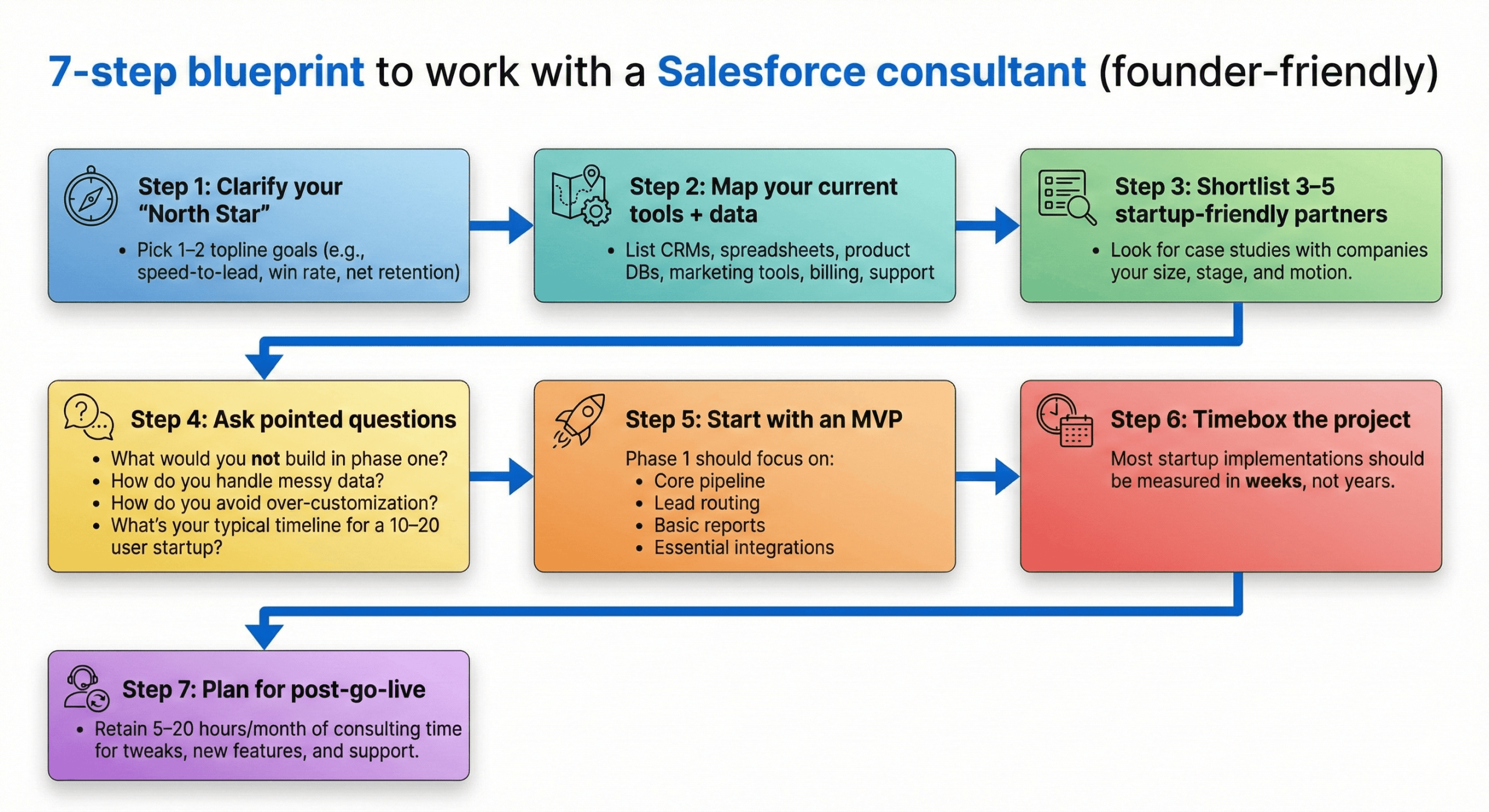
Step 1: Clarify your “North Star”
Pick 1–2 topline goals (e.g., speed‑to‑lead, win rate, net retention).
Step 2: Map your current tools + data
List CRMs, spreadsheets, product DBs, marketing tools, billing, support.
Step 3: Shortlist 3–5 startup‑friendly partners
Look for case studies with companies your size, stage, and motion.
Step 4: Ask pointed questions
What would you not build in phase one?
How do you handle messy data?
What’s your typical timeline for a 10–20 user startup?
Step 5: Start with an MVP
Phase 1 should focus on:
Core pipeline
Lead routing
Basic reports
Essential integrations
Step 6: Timebox the project
Most startup implementations should be measured in weeks, not years.
Step 7: Plan for post‑go‑live
Retain 5–20 hours/month of consulting time for tweaks, new features, and support.
Green flags:
Talks about outcomes before features
Proposes a phased roadmap (MVP → iterate)
Pushes back on “build everything now”
Uses words like “churn,” “LTV,” “CAC,” not just “objects” and “fields”
Has experience with other startups in your industry or stage
Red flags:
Heavy focus on custom code from day one
Multi‑month “discovery” for a 15-person team
No clear plan for migration or training
Wants to mirror your old broken system exactly
You might not be ready if:
You don’t have a repeatable sales motion yet
Leadership can’t agree on basic definitions (lead/MQL/SQL/opportunity)
You’re still validating product‑market fit with a tiny pipeline
In those cases, start simple with Starter/Free trial, keep data clean, and bring in a consultant once you see patterns worth scaling.
Salesforce CRM consulting for startups is not about buying a “fancy CRM project.”
It’s about buying speed, clarity, and a foundation you won’t have to rip out at Series B.
The right consultant helps you:
Turn your current GTM into a clean Salesforce blueprint
Launch a lean but powerful CRM in weeks
Automate the busywork that slows your team down
Grow from first hires to global teams without rebuilding everything
If you’re ready to make Salesforce the operating system for your go‑to‑market, start by defining your North Star metric and finding a partner who can get you there with the smallest, cleanest implementation possible.
Read more : The Hidden Costs of Salesforce Implementation: How to Avoid Budget Overruns [2025]

 Chatbot