
Hey there! If you’re diving into Salesforce implementation, you’re probably wondering how AI and automation can make the whole process smoother, faster, and way more effective.
In simple terms, AI in Salesforce implementation powers smart predictions and personalization, while automation handles repetitive tasks like data entry and workflows.
Together, they cut down implementation time, boost accuracy, and help businesses hit the ground running with a CRM that feels like it reads your mind.
Think about it: traditional Salesforce setups often drag on due to manual configs, data migration headaches, and user training woes.
But with tools like Salesforce Einstein, AI-driven automation steps in to predict issues, auto-generate configs, and optimize processes right from the discovery phase. Whether you’re a small team or a big enterprise, these technologies turn complex projects into efficient wins.
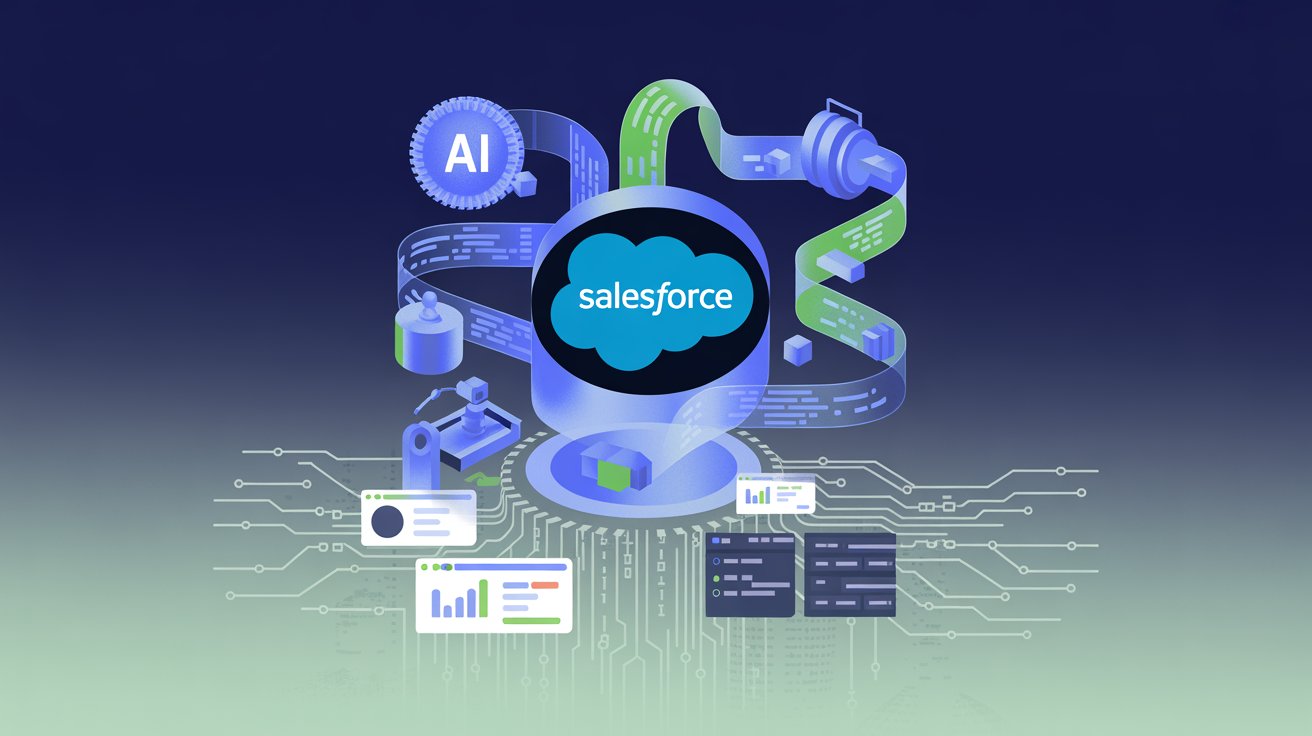
Salesforce Einstein is the star here – it’s the platform’s built-in AI layer that crunches your data for insights without needing a data scientist on speed dial. Einstein GPT, for instance, generates emails, reports, and even code snippets using natural language prompts, making implementation feel conversational.
Other gems include Einstein Prediction Builder for no-code forecasts on leads or churn, and Einstein Copilot, your AI sidekick for tasks like record updates or querying data.
In Salesforce implementation, these tools shine by analyzing org metadata, spotting gaps early, and suggesting custom objects or flows – saving weeks of trial-and-error.
Predictive analytics: Scores leads and forecasts sales to prioritize during setup.
Generative AI: Auto-creates user stories, test cases, and proposals for agile projects.
Process mining: Identifies workflow bottlenecks pre-go-live.
Salesforce automation isn’t just buzz – it’s tools like Flow Builder, Workflow Rules, and Approval Processes that zap manual grunt work. During implementation, Flow Builder lets you drag-and-drop complex logic for data syncs or notifications, no Apex code required.
Pair it with AI automation, and you get smart routing: cases go to the right agents, approvals trigger instantly, and emails personalize on autopilot. Einstein Flow Orchestrator even decides task handoffs based on data patterns, making your org hum efficiently from day one.
Here’s how it breaks down in practice:
Let’s walk through a typical Salesforce implementation lifecycle – discovery, design, build, test, deploy – and see the magic.
Discovery Phase: AI agents like those in GetGenerative.ai scan docs and transcripts to extract requirements, generate proposals, and estimate efforts. No more endless meetings!.
Design & Build: AI breaks features into user stories, suggests field mappings, and avoids duplicate configs by scanning your metadata. Automation pushes these to Jira or dev tools seamlessly.
Testing & Deploy: Auto-generate test cases tied to stories, run defect tracking, and use predictive AI to flag risks like data inconsistencies. Agentforce even simulates user interactions 24/7.
Real-world wins? Consultancies cut proposal time by 80%, while enterprises see 83% revenue growth post-AI rollout.
The payoff is huge and measurable. Increased efficiency frees admins for strategy – automate data entry, and watch productivity soar.
Better decisions: AI insights predict adoption hurdles or scalability needs.
Scalability: Handles growth without rework, thanks to Hyperforce architecture.
User adoption: Chatbots train staff, personalized dashboards engage them.
Data quality improves too – AI cleans migrations, spots biases, and ensures GDPR compliance via Trust Layer.
Not all smooth sailing, though. Common hurdles? Poor data readiness or over-customization leading to tech debt. Ethical AI concerns like bias need addressing early.
Pro tips:
Start small: Pilot Einstein on one cloud (e.g., Sales Cloud).
Partner up: Certified pros handle hybrids of in-house and AI tools.
Future trends? Voice-activated CRM, IoT integration, and deeper generative AI for hyper-personalization.
Retail: AI forecasts demand during setup, automates inventory flows.
Healthcare: Predictive patient routing cuts wait times.
Finance: Fraud detection automations baked in from launch.
These aren’t hypotheticals – 78% of orgs now use AI in Salesforce, driving real growth.
In wrapping up, embracing AI and automation in Salesforce implementation isn’t optional anymore – it’s your edge in a data-driven world. Ready to supercharge your next project? Dive into Einstein today and watch your CRM transform.
Embracing the role of AI and automation in Salesforce implementation transforms overwhelming projects into streamlined successes, from Einstein GPT accelerating discovery to Flow Builder automating workflows and Agentforce ensuring flawless deploys.
Businesses unlock massive gains: 80% faster timelines, 83% revenue boosts, superior data quality, and effortless scalability across retail, healthcare, and finance.
By starting small, prioritizing clean data, and partnering with experts, you sidestep pitfalls like tech debt while future-proofing with trends like voice CRM and IoT. Ready to elevate your CRM? Dive into Salesforce Einstein today – your competitive edge awaits in this AI-powered era.

 Chatbot